
Sector modules
Deep-dive for high-risk sectors
The EU AI Act classifies AI applications in certain sectors as high-risk. These deep-dive modules cover the sector-specific legislation, risks and scenarios relevant to your field.
Sector modules are in addition to the base modules (M1-M4) and intended for employees working in a high-risk sector.
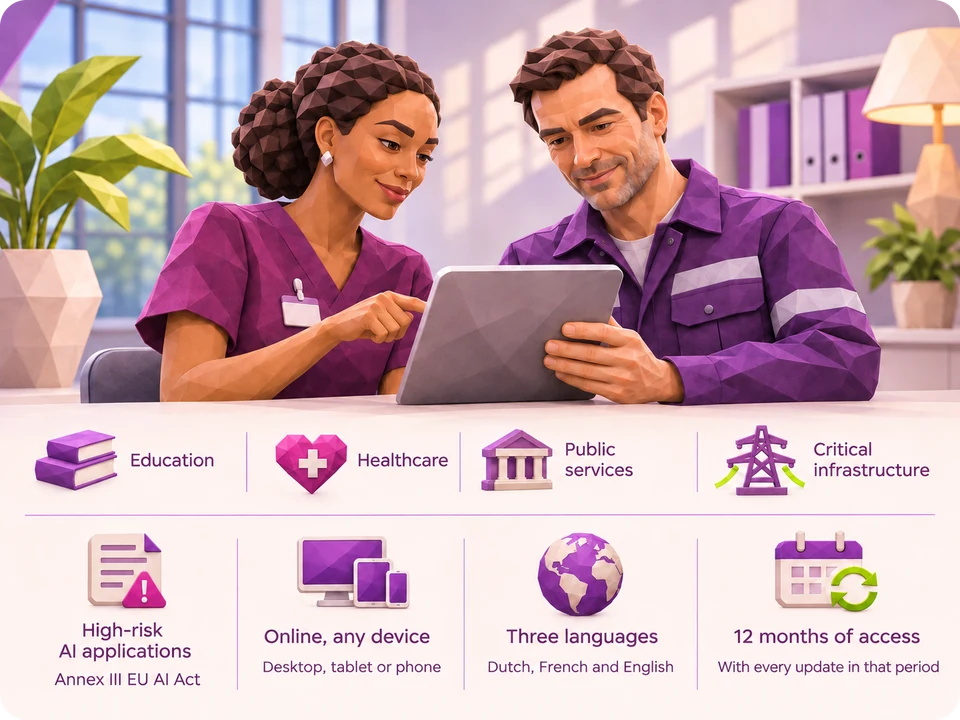
- 4 sector modules. Education · Healthcare · Public · Critical infra
- High-risk AI applications. In line with Annex III EU AI Act
- Online, any device. Desktop, tablet or phone
- Three languages. Dutch, French and English
- 12 months of access. With every update in that period
Content by sector
Four deep-dive modules for four high-risk sectors. Each module has 6 lessons with sector-specific scenarios, legislation and real cases.
M3-ON: Education training
- 👤 Teachers, examination boards, admissions staff
- ⏱ ±30 min
- 📝 6 lessons
- ✅ Exam: 10 questions
- 🏆 Certificate at 70%
- 💶 €40 excl. VAT
- 🔄 12 months of access
- 🌍 NL · FR · EN
The 6 lessons
- 1AI in your work as a teacherWhere AI already sits in your teaching work and what the EU AI Act asks of you
- 2Why certain AI in education is high-riskAssessment, admission and pupil-tracking as high-risk applications (Annex III)
- 3Bias: how AI discriminates unintentionallyHow unfair outcomes arise and how to spot them in time
- 4Human oversight: the teacher decidesYou keep effective oversight; the system does not decide for you
- 5Privacy and transparencyHandling pupil data with care and being open about AI use
- 6Red flags and escalationRecognising the signals and reporting them through the right channel
M3-ZO: Healthcare training
- 👤 Doctors, nurses, diagnostic staff
- ⏱ ±30 min
- 📝 6 lessons
- ✅ Exam: 10 questions
- 🏆 Certificate at 70%
- 💶 €40 excl. VAT
- 🔄 12 months of access
- 🌍 NL · FR · EN
The 6 lessons
- 1AI in your work as a healthcare professionalWhere AI already sits in your care work and what the EU AI Act asks of you
- 2Why certain AI in healthcare is high-riskDiagnostics, triage and decision support as high-risk applications (Annex III)
- 3Bias: how AI discriminates unintentionallyHow unfair outcomes arise and how to spot them in time
- 4Human oversight: the healthcare professional decidesYou keep effective oversight; the system does not decide for you
- 5Privacy and transparencyHandling patient data with care and being open about AI use
- 6Red flags and escalationRecognising the signals and reporting them through the right channel
M3-PD: Public services training
- 👤 Policy officers, front-desk staff, permit officers
- ⏱ ±30 min
- 📝 6 lessons
- ✅ Exam: 10 questions
- 🏆 Certificate at 70%
- 💶 €40 excl. VAT
- 🔄 12 months of access
- 🌍 NL · FR · EN
The 6 lessons
- 1AI in your work as a civil servantWhere AI already sits in your public-service work and what the EU AI Act asks of you
- 2Why certain public decisions are high-riskAI in benefits, permits and enforcement as high-risk applications (Annex III)
- 3Bias: how AI discriminates unintentionallyHow unfair outcomes arise and how to spot them in time
- 4Human oversight: the public authority stays responsibleYou keep effective oversight; the system does not decide for you
- 5Privacy and transparencyHandling citizen data with care and being open about AI use
- 6Red flags and escalationRecognising the signals and reporting them through the right channel
M3-KI: Critical infrastructure training
- 👤 Operators, control-room staff, technical management
- ⏱ ±30 min
- 📝 6 lessons
- ✅ Exam: 10 questions
- 🏆 Certificate at 70%
- 💶 €40 excl. VAT
- 🔄 12 months of access
- 🌍 NL · FR · EN
The 6 lessons
- 1AI in your work in critical infrastructureWhere AI already sits in critical-infrastructure work and what the EU AI Act asks of you
- 2Why certain AI in critical infrastructure is high-riskAI in energy, water and transport as high-risk applications (Annex III)
- 3Errors and bias in AI-driven systemsHow errors and unfair outcomes arise and how to spot them in time
- 4Human oversight: the operator keeps effective controlYou keep effective oversight; the system does not decide for you
- 5Cybersecurity and transparencyDigital resilience and being open about AI use
- 6Red flags and escalationRecognising the signals and reporting them through the right channel

Sector-specific certificate
- ✓Sector-specific learning outcomes — exactly which sector risks and legislation were covered
- ✓EU AI Act articles covered — including the Annex III classification for your sector
- ✓In addition to the base certificate — shows deeper knowledge for high-risk sectors
- ✓Certificate ID — a unique number per sector module
- ✓Date and training version — so you can see which version someone was tested on
- ✓12 months of access — with every update, after that you buy the module again
Frequently asked questions
Do I need to do the base training first?
The sector modules are in addition to the base modules (M1-M4). We recommend completing the relevant base module first, so you have the general AI Act knowledge before diving into the sector-specific deep-dive.
Which sector module suits my organisation?
Choose the module that matches the sector your employees work in. A local authority often chooses Public services (M3-PD), a hospital chooses Healthcare (M3-ZO). Employees active in more than one sector can take several modules.
How much does a sector module cost?
€40 per person per module, for 12 months of access with every update. This is in addition to the base module.
Do I get a separate certificate?
Yes, each sector module produces its own certificate with sector-specific learning outcomes. This certificate is in addition to the base certificate and shows that your employee has in-depth knowledge for the high-risk sector.
How does the exam work?
Just like the base modules: an exam with 10 randomly drawn multiple-choice questions. 70% is the pass mark (7 out of 10 correct). Each attempt gives you new questions. Unlimited retakes.
Does your organisation work in a high-risk sector?
Build a quote with the base modules and the sector module that suits your organisation.